Freycinet National Park



February 9, 2026
This morning we had breakfast overlooking Coles Bay and started on our first of three lodge activities. We were driven in a van about fifteen minutes to the trailhead for the Wineglass Bay Lookout in Freycinet National Park. From there we walked up to a saddle that has a panoramic view of both sides of the peninsula. We were lucky it was a sunny day without clouds and we could see the contrasting colors of the water in the bay and lagoon.


To the left is a photo taken from the hotel showing the direction we are headed. Our walk takes place in the saddle to the right in that photo. The right photo was taken on our walk and shows our lodge across the bay (peaked roof structure).


Here’s the iconic view of Wineglass Bay from the lookout.


Some rocks near the top, and a map showing the walk.

The above view from the Hazards is sunnier than when we arrived yesterday. Below, you can see the Wineglass Bay lookout, the rocky area in the saddle in the middle of the photo.


Here is a panorama of the whole Hazards range.
The total walk, which included many stairs, gained an elevation of over 200 meters in a distance of 3.75 kilometers. A bit tiring but well worth the effort.
We returned to the Lodge for showers and lunch. Our first activity of the afternoon was a trip to Craige Knowe Winery, about a half hour drive from the lodge. There we were given an informative tour of the vineyards by a farmer, with a discussion of the challenges of growing wine grapes in this region. We were told this summer’s lack of sunshine meant the harvest would be close to a month later than usual. It has also been unusually dry this year.
We then entered a winery building, where we were offered a well-designed tasting of six wines, paired with interesting food bites. Here’s a photo of the set-up.

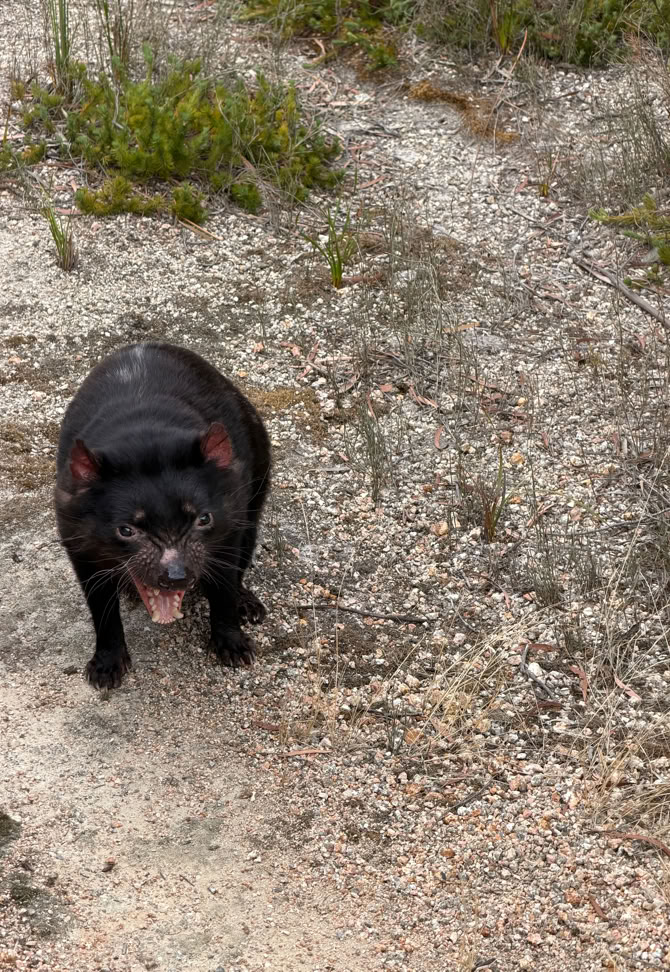
When this concluded, we were driven about a half hour back to the Lodge, where we were quickly whisked to our final daily activity, the Tasmanian Devil feeding. The Lodge has a large enclosure housing eight Devils, which is part of the Save the Devil program. Again, the menu was wallaby and we got very close views of their devils. These animals were primarily ones that had been retired from other breeding programs and were given a comfortable place to live out their days since they cannot be released.
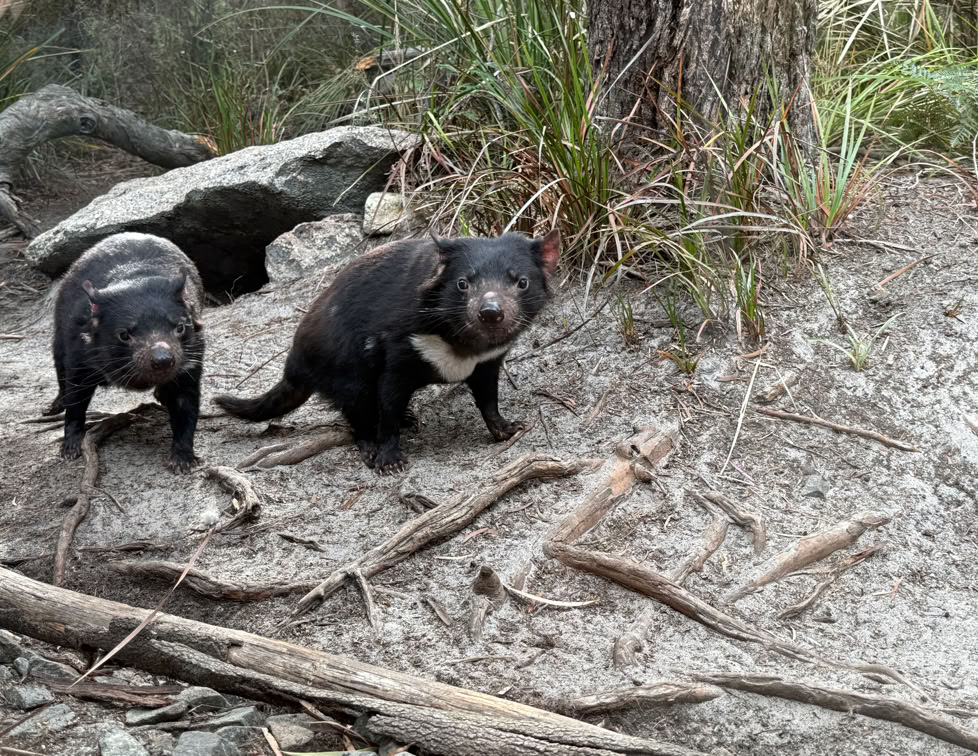
Here are three of the seven
female devils we saw.
Look at the teeth to the right!
It was a full and satisfying day.
February 10, 2026
This morning we took walks to a different part of Freycinet National Park, located on the ocean side of the Peninsula. The first walk was about a kilometer out to several viewpoints over Sleepy Bay, ending at a nice rocky beach with colorful shells. The rocks in this area are a deep rose color. We heard about the famous rose granite previously mined in this area and sent to Italy. It is common in places built up until about the 1980’s.


Here are some photos from our Sleepy Bay walk that illustrate the rose tint of the rocks.
We then drove five minutes or so to a shorter walk at Cape Tourville Lighthouse. This viewpoint was perched high above the sea, looking down a nearly vertical cliff of granite. There were two islands offshore teaming with bird life and fur seals.

We went several places, like above, where the rocks looked to us like basalt, but we were told they were dolerite.


The photo above shows the rock with seals and the photos to the left were also taken at Cape Tourville.
On the trail back to the car, we encountered more friendly wallabies. When first arriving in Tasmania, seeing the plentiful roadkill is stressful for a visitor, and is, we estimate, about 80% wallabies. But several guides have told us that the wallaby population is huge and healthy and has not yet been decimated by auto collisions. It is still sad to see all the dead animals on the highways. This is why tourists (and locals for that matter) are advised not to drive at night, if possible.
We then returned to the lodge for a little down time and lunch before heading out on an afternoon excursion. Today we were driven north in the direction of Bicheno which we had visited a couple of days ago. When we left the lodge it was cloudy but by the time we got to Bicheno, there was bright sunshine.
We visited a small craft distillery located at the Bicheno port. We had a tour of the facility and tasted pre-bottled spirits from different phases of the process right from the vats. We also saw the barrel aging room with barrels in lots of different sizes made from a variety of woods. Since barrels can typically only be used once for wine, they get repurposed for whisky.
We then went to the tasting room where we tasted five different whiskies in increasing price and alcohol content. The last one exceeded 60% ABV. The flavors varied as we progressed through the tastings. Overall, we found these whiskies a little too strong for our palates, but we understand Tasmanian whisky is very popular, and learned that there are many producers.


Photos of the barrel room, the kettles (top right), the outside of the distillery (bottom left) and Bicheno Harbor.


We then returned in the late afternoon to our room at the lodge and spent some time reading and enjoyed watching the view of the Hazards (the mountains across the bay).
We have one more activity tomorrow before leaving this wonderful lodge.
February 11, 2026
Check-out time today was during our morning activity, so we loaded up our luggage after breakfast before heading out. Our guide drove us about ten minutes to the Coles Bay marina, where we and a few other guests boarded a specially outfitted speedboat. The boat had comfortable chairs and a top cover, but was open on the sides. We were therefore provided large garments to put over our clothes to keep us warm and dry.
The first part of the cruise stopped at a few sites inside Oyster Bay. These included an old quarry for the rose colored granite, a beautiful white sand beach and a spot where we again saw some white chested sea eagles. Here are photos of the beach and eagles.


As we came around the point towards the open ocean, the colors of the granite were amazing, bright oranges and reds. As we reached the open ocean, it was clear the heavy swells would make going to Wineglass Bay (to the north) problematic, so we turned south instead.
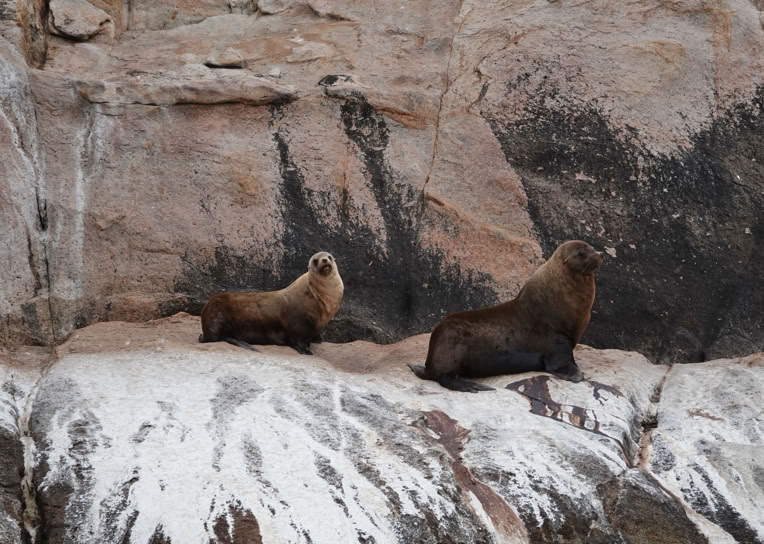
We cruised around Schouten Island, where we saw fur seals, dolphins, pied cormorants and shy albatross. This was exciting, because we have never been able to successfully photograph an albatross before. Here we saw a few flying and a others floating peacefully in the sea. We even saw one flying above and make a graceful ocean landing.
We then stopped in Hen and Chicken Bay to have tea and scones before cruising back to the marina. The cruise was a little under three hours.


Several photos showing the red rocks and birds, including an albatross.
Here are a few photos of fur seals.


Two final photos
from the cruise.
We returned to the lodge for one last lunch and then retrieved our car and luggage before heading south in the direction toward Hobart.
Here is the map of our route to Freycinet which includes the sites we visited in our time there. Zoom in to see the details.
We drove about an hour and a half to the very small town of Triabunna (population under 1,000), which is the launching point for trips to Maria Island. This very small town is equipped with a modern laundromat, so we washed our clothes.
It was very warm today, but started to sprinkle when we got to town. Tomorrow we will be heading on a cruise to Maria Island, before heading to Hobart, our last stop of the trip.
